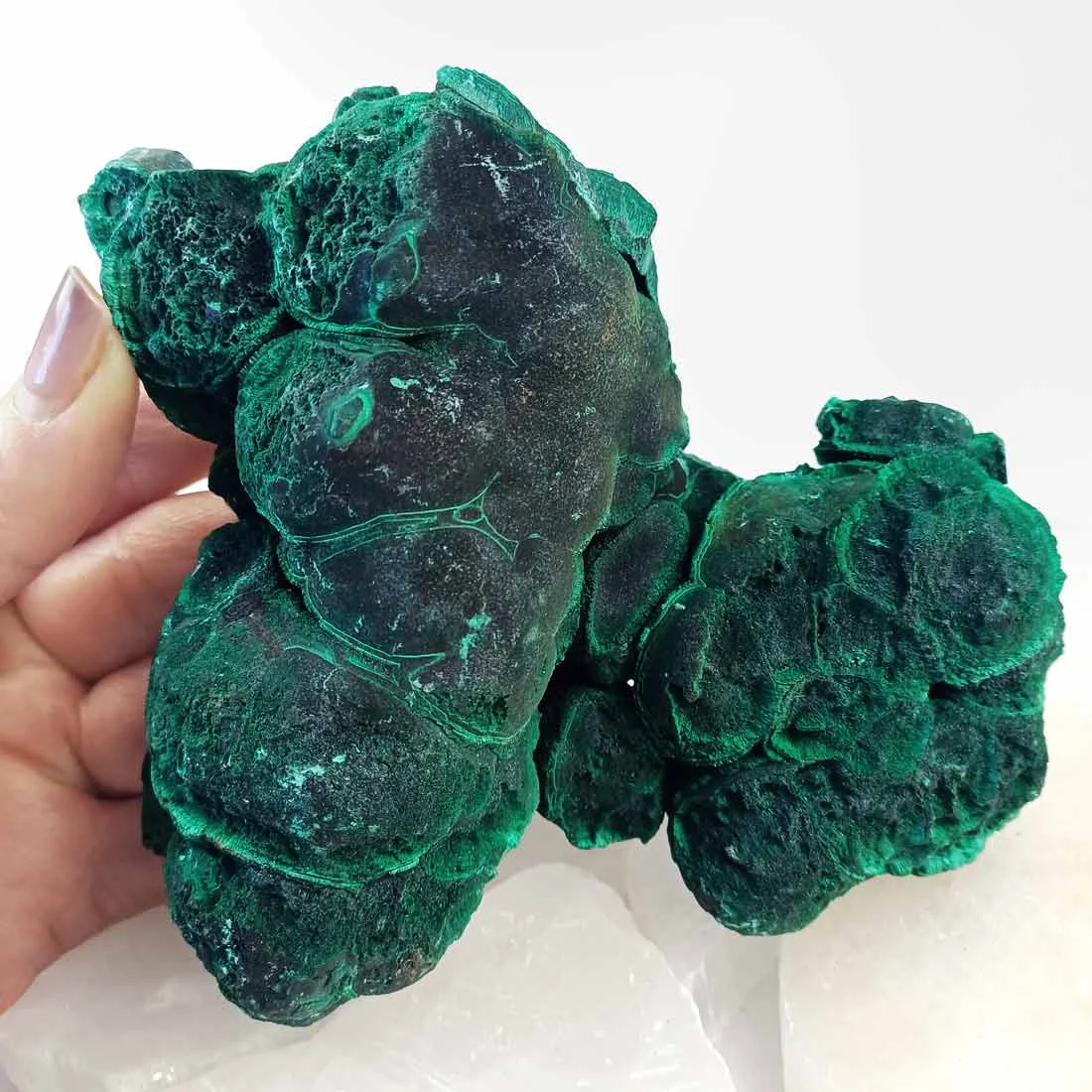
What Makes This Piece Unique
This is a one-of-a-kind specimen of botryoidal fibrous malachite, where both the external shape and internal structure formed naturally as a single piece. Unlike grouped or cut specimens, this piece represents an individual mineral formation shaped entirely by geological processes.
The botryoidal surface shows rounded, grape-like forms, while the internal structure consists of fine, radiating fibrous crystals. This combination creates a balanced contrast between smooth external curves and detailed internal growth patterns.
What is Malachite?
Malachite is a crystal composed of copper carbonate hydroxide Cu2CO3(OH)2Cu₂CO₃(OH)₂Cu2CO3(OH)2. It forms in the oxidation zones of copper deposits, where chemical reactions transform primary copper minerals into secondary minerals over time.
Its formation is closely linked to the presence of copper-rich solutions interacting with carbonate-bearing environments, leading to layered and structured mineral growth.
What Does Botryoidal Mean?
The term botryoidal comes from the Greek word for “grape” and is used in mineralogy to describe a surface that forms rounded, bulbous shapes clustered together, similar to a bunch of grapes.
This structure develops when minerals grow outward from multiple points at the same time. Instead of forming flat crystal faces, the material builds up in smooth, curved layers. In malachite, this often happens alongside fibrous crystal growth, giving the stone both its rounded exterior and its fine internal texture.
Color and Structure
The deep green color of malachite is a direct result of its copper content. In this specimen, variations in tone reflect subtle changes in mineral concentration and formation conditions.
The botryoidal structure forms through concentric layering, while the fibrous crystal growth radiates outward from central points. This creates natural patterning and texture unique to this individual piece.
How Does Botryoidal Fibrous Malachite Form?
It forms through the weathering of primary copper minerals such as chalcopyrite or bornite. As these minerals break down, copper ions are released and combine with carbonate ions.
Under stable conditions, malachite begins to deposit in rounded forms. Over time, fibrous crystals grow radially, layer by layer, producing the botryoidal shape combined with internal fibrous texture.
Origin: Congo
The Democratic Republic of Congo is one of the most important global sources of high-quality malachite. Specimens from this region are known for their strong color, well-defined formations, and structural clarity.
This piece reflects those characteristics, offering a natural example of mineral development from one of the most mineral-rich areas in the world.
Care and Handling
With a Mohs hardness of 3.5–4, malachite is relatively soft and should be handled carefully to avoid scratches or damage. This piece is best suited for display.
Clean with a soft cloth.